How to Convert a Powder Formula Into Gummies Without Losing the Meaningful Dose
Powder formulas are built around mass capacity. Gummies are built around a chewable structure. Moving a formula from powder to gummy therefore creates a risk: the brand may preserve the ingredient list while reducing every active until the original product purpose disappears.
A meaningful conversion begins by identifying which dose defines the product, then determining whether a realistic gummy serving can carry it. If the answer is no, a soft chew, jelly, liquid, capsule, or smaller supporting gummy may be a better extension.
The goal is not to force the same label into a new shape. It is to create a format that still makes commercial and technical sense.
Quick Answer
Protect the Hero Dose First
Use this sequence:
-
Calculate the total raw-material mass in one powder serving
-
Identify the hero ingredient and supporting ingredients
-
Define the minimum acceptable dose for each
-
Set the maximum gummies and target piece weight
-
Calculate the active percentage required
-
Review taste, heat, pH, water, and interactions
-
Compare gummy, soft-chew, jelly, and other routes
-
Develop and test the target-dose version
-
Validate commercial scale-up and packaging
If a powder contains 10g or 20g of active ingredients, a few small gummies cannot reproduce it. The brand must change serving architecture, simplify the formula, or select a higher-capacity format.
Define the Meaningful Dose
Do Not Start With the Gummy Count
The first question is not “Can we make two gummies?” It is “What amount must the consumer receive for this product to remain coherent?”
Separate the formula into:
-
Hero dose: the amount central to the product promise
-
Required support: ingredients that materially support the concept
-
Optional support: ingredients included mainly for label breadth
-
Flavor or base components: ingredients that belong to the powder system, not the active proposition
This prevents a formula from becoming a collection of underdosed label decorations.
Claims and dose rationale should be reviewed for the intended market. Published research on an ingredient does not automatically substantiate the finished combination or marketing language.
Calculate the Real Powder Mass
Label Amounts May Understate the Raw-Material Requirement
The Supplement Facts panel may declare elemental minerals, standardized botanical markers, vitamin activity, or protein, while manufacturing uses a larger mass of compounds, extracts, and premixes.
For every ingredient, record:
-
Declared amount
-
Material form
-
Supplier specification and assay
-
Raw-material input required
-
Carrier or excipient contribution
-
Bulk density and particle properties
-
Sensory contribution
Add the true raw-material mass per serving. Then compare it with the total mass available in the proposed gummy serving after the gel system is included.
Understand Gummy Load
The Finished Gummy Is Not an Empty Container
A gummy needs sweeteners or fibers, water, hydrocolloid, acids, flavors, colors, and process allowances. The active materials must be dispersed through this system while the product remains depositable and able to set.
As powder load increases, risks include:
-
High viscosity
-
Poor suspension or dispersion
-
Depositing inconsistency
-
Unit-weight variation
-
Weak or hard texture
-
Grittiness
-
Difficult drying
-
Surface sticking or cracking
-
Flavor masking failure
There is no universal maximum active percentage. Soluble vitamins, dense minerals, fibrous botanicals, proteins, and creatine behave differently.
Rebuild the Serving Architecture
Compare Pieces, Weight, and Total Daily Mass
The manufacturer should model several scenarios:
-
More gummies at a familiar piece size
-
Larger gummies with fewer pieces
-
Higher-load gummies with a denser bite
-
Reduced formula focused on the hero active
-
Soft chews carrying more powder per unit
-
Jelly or liquid sachets with more total serving mass
For each option, compare active per unit, pieces per serving, total serving weight, calories or sweetener system, bottle count, cost, and consumer use.
A six-gummy serving may be technically workable but commercially unattractive. A two-gummy serving may be impossible at the intended dose. The decision should be made before flavor development.
Ingredient Solubility and Suspension
A Clear Gummy Is Not the Default for High-Load Formulas
Some powder ingredients dissolve; others remain suspended. Insoluble minerals, proteins, fibers, and plant powders can make the gummy opaque and affect texture.
Review:
-
Particle size
-
Density and settling
-
Hydration and swelling
-
Solubility at process pH
-
Interaction with pectin or gelatin
-
Color and visual appearance
-
Extraction during testing
Grinding a material finer can reduce perceived grittiness, but it can also increase viscosity or change processing. A clear appearance should not be prioritized over honest dose delivery.
Heat, Acid, Moisture, and Oxygen
Powder Stability Does Not Automatically Transfer
A dry powder may be stable because it has low water availability and limited processing exposure. A gummy introduces water, acidity, heat, oxygen, and a moist storage matrix.
Sensitive probiotics, enzymes, vitamins, botanical compounds, oils, or creatine need product-specific review. Options may include late addition, protected ingredient forms, reduced process temperature, controlled hold time, overage where justified, or another format.
Do not add large overages as a substitute for understanding degradation. The finished product must remain safe, within specification, and consistent through its intended shelf life.
Taste and Consumer Burden
The Complete Serving Must Be Acceptable
Powders can use a large flavor system and significant dilution. Gummies concentrate the ingredients into a chewable mass held in the mouth.
Common sensory problems include bitterness, metallic notes, astringency, saltiness, sourness, botanical odor, protein notes, and powder perception.
Approve:
-
The intended active dose
-
The intended number of gummies
-
The commercial unit weight
-
The selected sugar or fiber system
-
The target flavor and color
-
The full serving consumed together
One good-tasting low-dose gummy does not validate a high-dose serving.
Sugar and Sugar-Free Systems
Changing the Sweetener System Changes the Structure
A conventional gummy can use sucrose and glucose syrup to provide solids, sweetness, texture, and moisture behavior. A sugar-free version may use polyols, soluble fibers, high-intensity sweeteners, and other bulking components.
These systems have different water activity, hygroscopicity, crystallization, digestive-tolerance, and processing behavior. Sugar-free should be treated as a separate formulation route, not a simple sweetener substitution.
For a high-load conversion, the active powder and fiber or polyol system compete for limited mass and can make the chew dense or sticky.
When Soft Chew Is Better
Use a Structure Designed for Powder Load
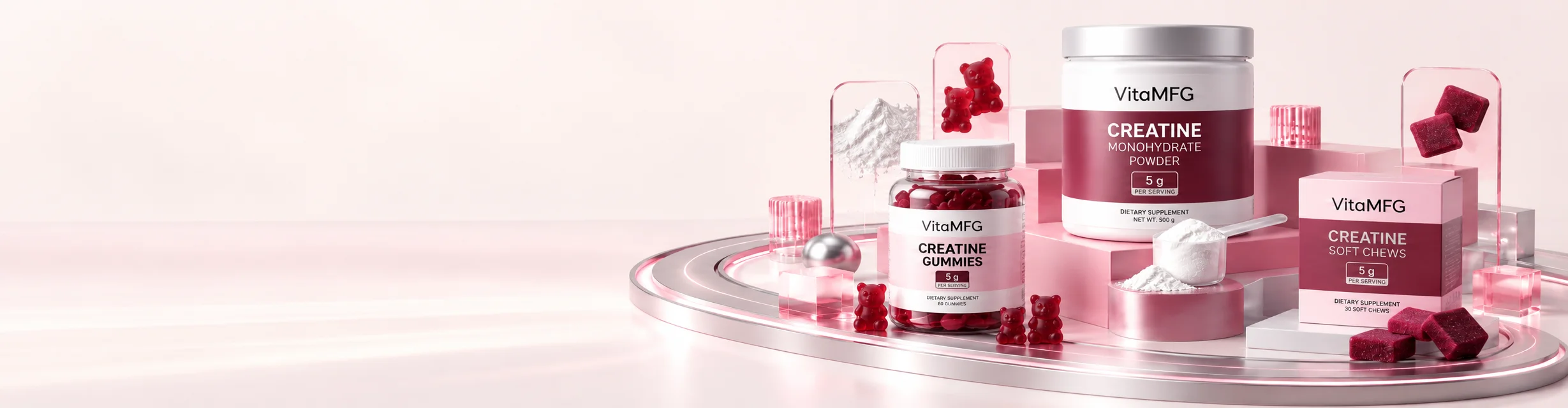
Soft chews can support a larger functional powder proportion and fewer pieces. They are especially relevant for creatine, collagen, minerals, and other gram-level ingredients.
Potential benefits include:
-
Higher active load
-
Lower unit count
-
Reduced need for a translucent gel
-
Cold-processed or lower-heat route on suitable platforms
-
Dense, snack-like texture
Risks include cohesion, crumbling, deformation, dryness, surface oil, flavor, water activity, packaging, and scale-up. Soft chew is not an automatic solution; it is a different engineering system.
When Jelly or Liquid Is Better
More Serving Mass Can Solve the Capacity Problem
A jelly sachet or liquid shot provides more total mass and can carry ingredients that do not fit a few gummies. This can support single-serve portability without requiring a scoop.
The trade-offs include water activity, microbial control, viscosity, filling, heat treatment, preservative strategy, package integrity, and transport weight.
For ingredients unstable in acidic aqueous systems, a larger wet format may increase rather than reduce stability risk. Format choice must consider both capacity and compatibility.
Finished-Product Specifications and Testing
The Converted Product Needs Its Own Evidence
Define specifications for identity, strength, composition, contaminants, unit weight, physical quality, microbiology, and packaging as appropriate.
The analytical method must suit the gummy matrix. High active loading, fibers, colors, flavors, acids, and multiple ingredients can complicate sample extraction.
Use representative sampling. Beginning-middle-end or individual-unit testing may be important when suspended powders can settle or when the active is distributed across several gummies.
The powder's existing COA or stability report does not prove the converted gummy.
Commercial Scale-Up
High-Load Samples Often Change on Production Equipment
Commercial scale changes mixing energy, temperature, transfer time, hold time, settling, depositing pressure, line speed, drying, coating, and yield.
Validate:
-
Material addition and preblend
-
Dispersion and suspension
-
Process time and temperature
-
Gummy weight distribution
-
Beginning-middle-end content
-
Drying and water activity
-
Texture and sensory profile
-
Packaging-line performance
-
Repeat-batch reproducibility
The objective is not to make a perfect hand sample. It is to create a controlled product that can be repeated at commercial scale.
Conversion Red Flags
-
Serving count set before mass calculation
-
Every powder ingredient retained at token doses
-
A flavored blank approved instead of the target-dose product
-
Universal active-load percentage quoted without material review
-
Dry-powder stability copied to a wet gummy
-
Raw-material COAs presented as finished-product proof
-
Sugar-free described as a simple sweetener swap
-
Bench sample used as scale-up evidence
-
Package selected before moisture and sticking review
Powder-to-Gummy Decision Checklist
-
Hero dose and minimum acceptable amount defined
-
Actual raw-material mass calculated
-
Maximum units and total serving mass approved
-
Active-load feasibility reviewed
-
Sensitive and incompatible ingredients identified
-
Gummy, soft-chew, jelly, and other routes compared
-
Full-dose sensory sample approved
-
Finished-product methods established
-
Commercial-scale validation planned
-
Package and stability program selected
How VitaMFG Reviews Powder-to-Gummy Projects
Protect the Dose Before Choosing the Chew
VitaMFG reviews the quantitative powder formula, material assays, hero dose, other actives, desired units per serving, target market, flavor, sugar system, package, testing, and volume.
The concept is then modeled across gummy capacity, high-load soft chew, jelly, powder, or other formats. For gummy routes, active loading, dispersion, heat and pH exposure, taste, gel structure, moisture, finished-product verification, and scale-up are reviewed together.
If the original powder dose cannot fit a consumer-ready gummy serving, that conclusion is identified early rather than hidden through underdosing.
Frequently Asked Questions
Q1: Can a 10g powder serving become gummies?
It would require a very large total gummy mass and many pieces. Powder, jelly, or another high-capacity format is usually more practical.
Q2: Should we reduce every ingredient proportionally?
Usually not. Rank the hero and supporting ingredients, then redesign the product around a coherent dose and claim strategy.
Q3: Is a soft chew always higher load than a gummy?
It can support a higher powder proportion on an appropriate platform, but the exact capacity depends on the formula, unit design, process, and desired texture.
Final Recommendation
Convert the Product Purpose, Not the Ingredient List
A successful powder-to-gummy transfer preserves the hero dose and consumer benefit while redesigning serving size, ingredient forms, sensory system, process, testing, and package.
If you have the quantitative powder formula and target gummy count, VitaMFG can perform an initial feasibility review and compare gummy, soft-chew, and alternative routes.