What pH Does to Functional Gummies: Taste, Pectin Set and Active Stability
pH is one of the most influential—and most oversimplified—numbers in functional gummy development.
It affects sourness, pectin setting, color, flavor, microbial controls, and the chemical environment around active ingredients. Yet the same pH can behave differently when the formula changes its acids, buffers, solids, minerals, fibers, hydrocolloids, moisture, or process history.
The useful question is not “What is the best pH for gummies?” It is “What pH range supports this formula, process, active system, sensory target, and shelf-life plan?”
Quick Answer
pH Must Be Product-Specific
A defensible pH control strategy should define:
-
Why pH matters for the selected gel system
-
Which acids and buffers are present
-
How active ingredients change buffering
-
When acid is added during processing
-
How samples are prepared and measured
-
The acceptable in-process and finished range
-
How pH relates to moisture and water activity
-
Whether potency and degradation are followed on stability
-
What triggers investigation or reformulation
A copied number from another gummy is not a validated specification.
What pH Measures
Acidity Is More Than One Number
pH describes hydrogen-ion activity in the measured system. It is not the same as the total amount of acid present.
Titratable acidity measures the amount of base required to neutralize acids to a defined endpoint. Two gummies can have similar pH but different titratable acidity, buffering, sourness, and response during storage.
For product development, pH often helps control the process, while titratable acidity can help explain flavor and buffer capacity. Neither measurement replaces stability testing.
Acid Selection
Different Acids Create Different Products
Citric, malic, lactic, tartaric, fumaric, or other permitted food acids vary in solubility, taste profile, acid strength, and interaction with the matrix.
An acid blend may create a more balanced sour profile than one acid alone. It may also change pectin set, surface crystallization, flavor release, or active exposure.
Select acid type and amount around the whole formula. A sensory correction can become a processing or stability problem if its effect on pH and buffering is not measured.
Pectin Set
pH Can Define the Depositing Window
Pectin systems require the correct combination of pectin type, soluble solids, acidity, ions, temperature, and time. Acid can initiate or accelerate gel development, reducing the time available for transfer and depositing.
If acid is added too early, viscosity may rise in the vessel or lines. Depositing can become inconsistent, tails may form, and unit weights may drift. If the system does not reach its intended conditions, the gummy may remain weak or deform.
Do not manage pectin by final pH alone. Record acid addition point, temperature, hold time, viscosity behavior, and depositor performance.
Gelatin and Other Systems
pH Still Matters Even When It Does Not Trigger the Set
Gelatin, starch, agar, gellan, and blended systems respond differently from pectin. Acid exposure can influence protein structure, texture, flavor, color, and active stability even when the gel mechanism is different.
The selected system should be evaluated at the intended pH, temperature, solids, and active load. A blank confectionery base does not represent a high-mineral or high-acid supplement formula.
Taste and Flavor
Sourness Depends on the Complete Acid Profile
Consumers do not taste a laboratory pH number. They experience acid identity, titratable acidity, sweetness, flavor, salt, bitterness, cooling, aroma, and aftertaste.
Minerals and botanicals may raise buffering and require more acid to reach the same pH, producing a sharper or longer sour profile. High-intensity sweeteners can change how acidity is perceived.
Sensory approval should use the target-dose formula and the intended coating. Acid sanding can create a strong first impression while the gummy core has a different pH and flavor balance.
Active-Ingredient Stability
The Gummy Matrix Creates a Chemical Environment
Some vitamins, probiotics, botanical components, amino acids, and other actives are sensitive to acidity, heat, water, oxygen, or combinations of these factors.
Creatine is a useful example: evidence from aqueous systems indicates that conversion to creatinine increases under more acidic and warmer conditions. A gummy is not identical to a beverage, so solution data should identify risk rather than serve as finished-product shelf-life proof.
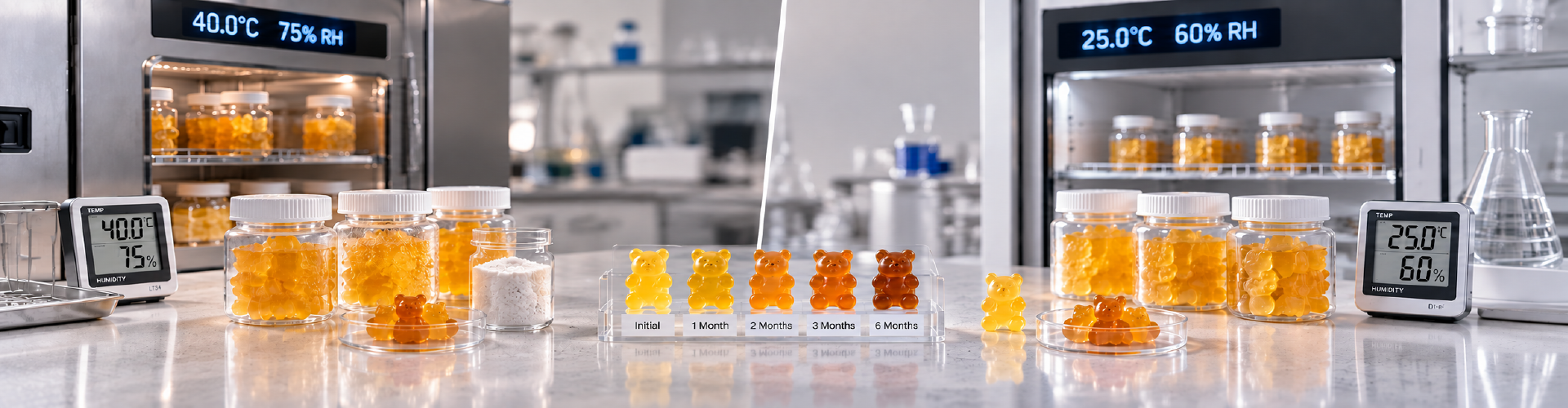
Evaluate the actual active in the final gummy, package, and storage program. When relevant, monitor both potency and a meaningful degradation product.
Buffering From Active Ingredients
Formula Changes Can Move pH Unexpectedly
Mineral salts, proteins, amino acids, botanical extracts, and premixes can resist pH change or shift it after addition.
This means a fixed acid weight may not deliver a fixed finished pH across raw-material lots or formula revisions. Supplier grade, assay, carrier, moisture, and particle form can contribute to variation.
Commercial controls should use measurement and approved ranges, not acid quantity alone.
Timing of Acid Addition
Process Sequence Changes Exposure
Adding acid before a long heat hold can expose sensitive ingredients to acidic conditions for longer than adding it shortly before depositing. Late acid addition, however, can create mixing and pectin-set challenges.
Define:
-
Acid solution concentration
-
Addition temperature
-
Mixing time and speed
-
Sampling point
-
Maximum hold before depositing
-
Response if pH is outside range
Unrecorded production adjustments can change both texture and chemical stability.
How to Measure Gummy pH
Use a Reproducible Preparation Method
A finished gummy is not a simple liquid. The laboratory may need to homogenize or disperse a defined mass in a defined amount of water before measurement.
The method should specify sample mass, dilution ratio, water quality, temperature, mixing or equilibration time, instrument calibration, electrode suitability, and replicate approach.
Results from different preparation methods may not be directly comparable. Use the same method for specification, release, investigations, and stability trending unless a controlled change is justified.
In-Process vs Finished pH
The Number Can Change After Depositing
Water loss, acid distribution, coating, ingredient equilibration, and storage can affect the measured result.
An in-process slurry pH helps operators control production. A finished-gummy pH supports the product specification. They may use different sample preparations and should not be confused.
Define the sampling stage and test method beside every limit.
pH, Moisture, and Water Activity
These Variables Work Together
pH can contribute to microbial control, but it does not replace water-activity control, sanitation, microbiological specifications, or validated processing.
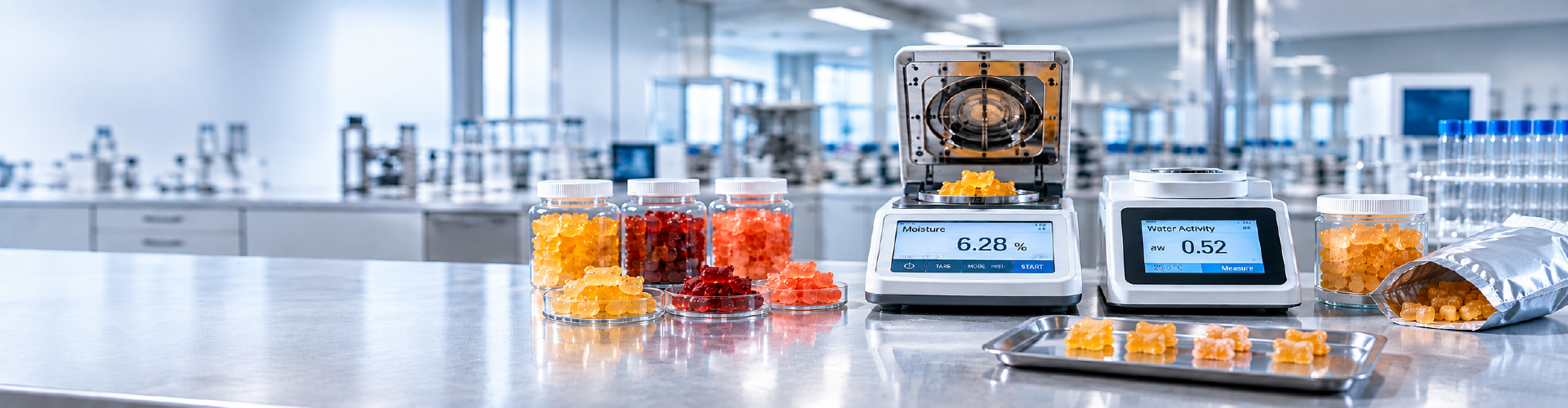
Moisture content measures total water. Water activity measures its availability. Acids, salts, sugars, polyols, and fibers influence water interactions.
A stable gummy requires a combined view of pH, water activity, moisture, package barrier, storage, and formulation—not a single “safe” number.
Commercial Scale-Up
Larger Batches Change Time and Mixing
At scale, acid addition and distribution may take longer. Product can remain in the vessel or transfer lines while viscosity changes.
During the commercial trial, review pH at defined points, mixing conditions, hold time, depositor performance, unit weight, finished texture, potency, and stability placement.
Beginning-middle-end samples can reveal whether the process drifted across the depositing run.
Common pH Mistakes
-
Selecting one universal pH for all gummies
-
Treating acid weight as proof of final pH
-
Using pH as the only microbial control
-
Ignoring titratable acidity and buffering
-
Measuring slurry and finished gummy with the same assumption
-
Changing active or mineral grade without rechecking pH
-
Adding acid earlier at scale without reviewing exposure
-
Approving flavor in an unloaded base
-
Claiming shelf life from pH alone
Questions for a Gummy Manufacturer
-
Why was the target pH range selected?
-
What method is used for in-process and finished measurements?
-
How do actives affect buffering?
-
When is acid added, and what is the maximum hold time?
-
How does pH relate to the pectin or gel system?
-
Are moisture and water activity specified separately?
-
Which actives or degradation products are followed on stability?
-
How are out-of-range adjustments controlled?
How VitaMFG Approaches Gummy pH
Link Measurement to Product Performance
VitaMFG reviews the gel system, acids, buffers, active load, sweeteners, flavors, target sensory profile, process sequence, package, and stability requirements.
The pH range is evaluated with depositing behavior, finished texture, moisture, water activity, active verification, and commercial stability. It is not selected as an isolated number.
Where the desired sourness, gel behavior, or active stability conflicts with another product requirement, development identifies the trade-off before commercial scale-up.
Frequently Asked Questions
What is the ideal pH for a functional gummy?
There is no universal value. The appropriate range depends on the gel system, formula, active ingredients, processing, microbial controls, package, and shelf-life evidence.
Is a lower pH always safer?
No. pH is only one control. Lower pH may create active degradation, texture, or sensory problems and does not replace water-activity and microbiological controls.
Can final pH be predicted from acid input?
Not reliably across formulas. Buffers, minerals, proteins, extracts, solids, and process conditions affect the result.
Should pH be tested during stability?
Yes, when it is a relevant product attribute. Trend it with potency, degradation, moisture, water activity, texture, and sensory changes.
Final Recommendation
Use pH as part of a controlled formulation system.
Define the reason for the target, standardize the measurement, control acid addition and hold time, and verify how pH interacts with gel formation, flavor, active potency, water activity, and shelf life.
VitaMFG can review the pH and processing risks of a functional gummy concept before formal sampling or commercial scale-up.
Reference Links
-
FDA: Water Activity in Foods — https://www.fda.gov/inspections-compliance-enforcement-and-criminal-investigations/inspection-technical-guides/water-activity-aw-foods
-
Electronic Code of Federal Regulations: 21 CFR Part 111 — https://www.ecfr.gov/current/title-21/chapter-I/subchapter-B/part-111
-
Review: Bioavailability, Efficacy, Safety, and Regulatory Status of Creatine and Related Compounds — https://pmc.ncbi.nlm.nih.gov/articles/PMC8912867/