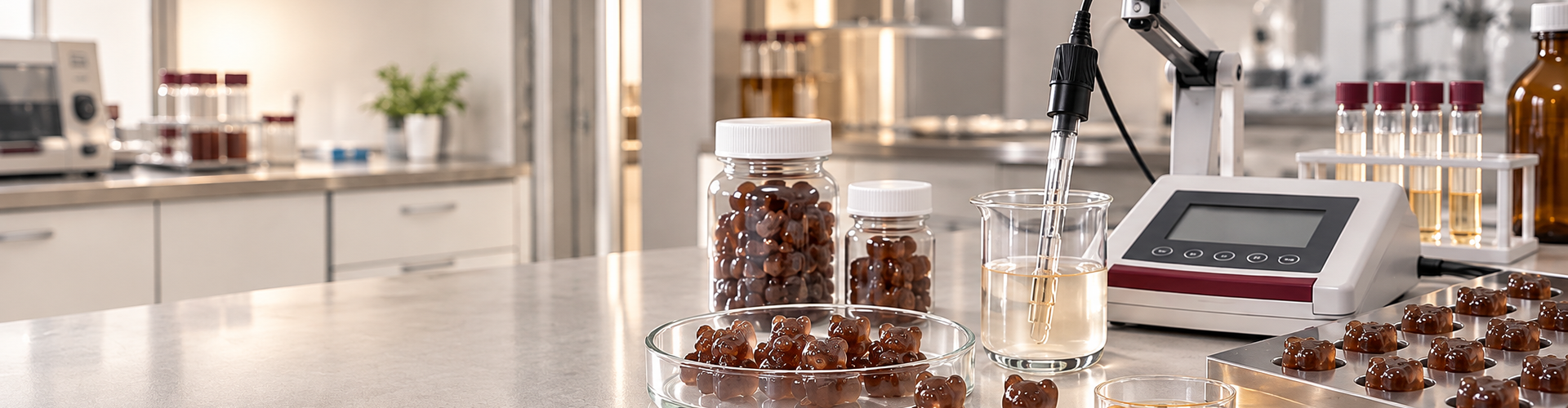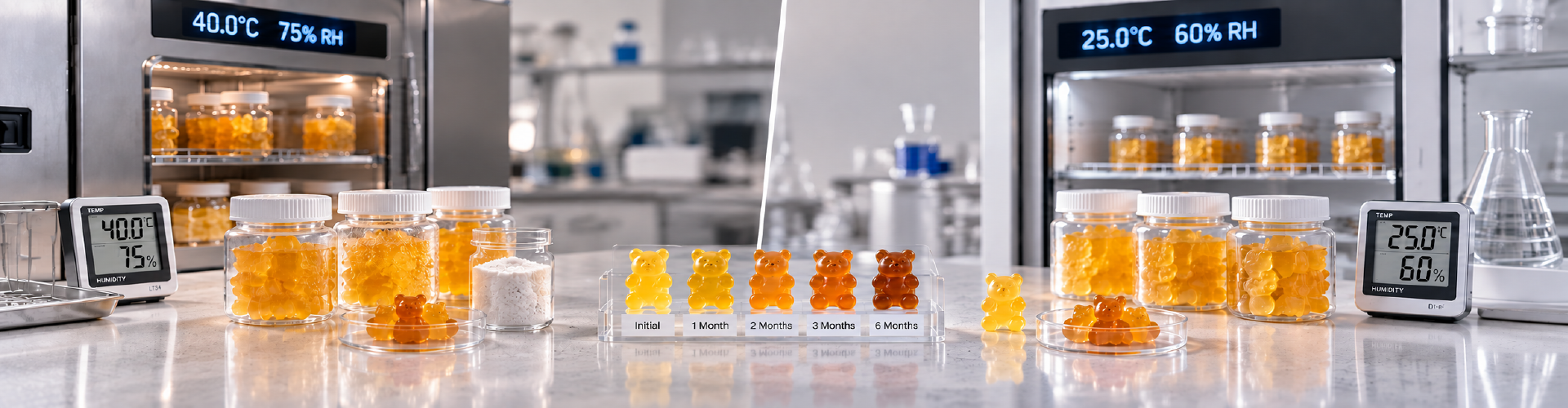
How Gummy Moisture and Water Activity Affect Texture, Sticking and Shelf Life
Moisture content and water activity are related measurements, but they do not mean the same thing. Moisture content describes how much water is present. Water activity describes how available that water is for physical, chemical, and microbiological processes.
This distinction matters in functional gummies. Two products can have similar moisture and different water activity because sugars, polyols, fibers, acids, salts, minerals, proteins, and other ingredients bind water differently.
The correct specification must connect both measurements to texture, sticking, active stability, microbiological control, packaging, and shelf life.
Quick Answer
Use a Product-Specific Moisture Window
Gummy quality depends on:
-
Formula water and solids
-
Sweetener or fiber system
-
Hydrocolloid
-
Active ingredient load
-
Cook endpoint
-
Drying and equilibration
-
Final moisture and water activity
-
Package moisture barrier
-
Storage temperature and humidity
There is no universal water-activity or moisture value suitable for every gummy. A target that works for a sucrose-glucose pectin gummy may not work for a sugar-free, high-mineral, collagen, or creatine formula.
What Moisture Content Measures
Total Water in the Sample
Moisture may be measured by loss on drying, oven, infrared, Karl Fischer, or another method depending on the product and purpose.
The method matters. Volatile flavors or other compounds can be lost during heating and counted as apparent moisture in some procedures. Sampling and grinding can also change results.
Define the method, sample preparation, temperature, time, and reporting basis. Do not compare moisture numbers generated by different methods without review.
What Water Activity Measures
Available Moisture at Equilibrium
21 CFR Part 111 defines water activity as the quotient of the water vapor pressure of a component or dietary supplement divided by the vapor pressure of pure water at the same temperature.
In practical terms, water activity reflects how strongly water is bound in the product. It influences microbial growth potential, moisture migration, texture, and some chemical reactions.
Measurement requires temperature control and time for the sample and instrument headspace to reach equilibrium. A warm gummy tested immediately after drying may not provide the same result as an equilibrated sample.
Why Similar Moisture Can Produce Different Texture
Ingredients Bind Water Differently
Sucrose, glucose syrup, polyols, soluble fibers, proteins, mineral salts, and acids interact with water through different mechanisms.
A gummy can contain substantial total water while keeping much of it tightly bound. Another formula with similar moisture can have more available water and feel softer or stickier.
Compare moisture and water activity together with solids, texture, and formulation. One number does not define the product state.
Texture
Water Controls Softness and Chew
As gummies lose moisture, they often become firmer, denser, and less elastic. Excessive drying can create a hard surface, cracking, or difficult chewing.
As gummies gain moisture, they may soften, deform, or become tacky. The gel network and sweetener system determine how rapidly these changes occur.
Track texture at release and during storage. Instrumental firmness can support control, but sensory chew and full-serving experience remain important.
Sticking
Surface Moisture Is Only Part of the Cause
Sticking can result from high surface water activity, incomplete drying, hygroscopic ingredients, warm storage, coating failure, package moisture ingress, or formula migration.
High-load gummies can also press more material against the surface and reduce structural resilience.
Investigate:
-
Drying uniformity
-
Equilibration after drying
-
Surface treatment
-
Product temperature before packing
-
Package barrier and closure
-
Storage humidity and heat
-
Piece shape and contact area
Adding more coating may temporarily hide the symptom without fixing moisture balance.
Drying and Equilibration
Release Values Can Change After the Dryer
Water continues to redistribute from the center to the surface after gummies leave drying. Measurements taken immediately may not represent the equilibrated product.
Define:
-
Incoming wet piece weight
-
Drying temperature and humidity
-
Airflow and tray load
-
Drying time
-
Target dry weight
-
Equilibration period
-
Sampling location
-
Final moisture and water activity
Beginning, middle, and end trays or room zones may dry differently. Commercial validation should map that variation.
Sugar-Free Gummies
Polyols and Fibers Create a Different Water System
Sugar-free gummies may use maltitol, sorbitol, erythritol, soluble fibers, or other bulking ingredients. These materials have different hygroscopicity, crystallization, sweetness, and water-binding behavior.
A sugar-free gummy can become sticky through moisture uptake or hard through crystallization and water redistribution. The correct formula needs both a solids strategy and a packaging strategy.
Do not copy conventional gummy moisture targets into a sugar-free product without data.
High-Load Gummies
Active Ingredients Change Water Binding
Creatine, collagen, minerals, botanicals, amino acids, and fibers can alter moisture distribution and gel structure.
Some powders absorb water and increase viscosity. Salts can change water activity and pectin behavior. Proteins and fibers can hold water while making texture dense.
Reassess moisture and water activity whenever active source, dose, particle size, or supplier changes. The active is not separate from the physical system.
Microbiological Risk
Water Activity Is Important, but Not the Only Control
Lower water activity can limit growth of many microorganisms, but the applicable limits and hazards depend on product, process, pH, ingredients, and intended consumer.
Water activity should complement hygienic manufacturing, qualified raw materials, safe water, environmental controls, appropriate microbiological specifications, and protective packaging.
A low reading does not prove the absence of microorganisms already present. Testing and process controls remain necessary.
Active Stability
Available Water Can Influence Chemistry
Water can support hydrolysis, mobility of reactants, color change, flavor change, and degradation of sensitive ingredients. Temperature and pH interact with these effects.
For creatine, acidic wet conditions and heat deserve review. Vitamins, probiotics, botanicals, and oils have their own sensitivities.
Use moisture and water-activity trends alongside active assay and degradation markers where relevant. Do not infer chemical stability from physical texture alone.
Packaging Interaction
The Package Can Drive Moisture Gain or Loss
Gummies exchange moisture with the surrounding environment until equilibrium is approached. Bottles, pouches, films, closures, liners, and seals slow that exchange to different degrees.
Evaluate:
-
Moisture-vapor transmission
-
Closure and liner
-
Seal integrity
-
Headspace
-
Desiccant where justified
-
Piece count and package volume
-
Repeated opening
-
Transport climate
A package that prevents moisture gain may also allow the gummy to continue drying if the internal balance is wrong. Packaging must be tested with the actual product.
Measurement Plan
Control Method, Temperature, and Sampling
Define:
-
Instrument and calibration
-
Sample size and preparation
-
Measurement temperature
-
Equilibration time
-
Sampling location
-
Number of replicates
-
Release limits
-
Stability time points
Record gummy age after drying when sampled. Comparing a two-hour sample with a seven-day equilibrated sample can create false conclusions.
Trend the results rather than reviewing isolated pass-or-fail values.
Common Problems and Likely Questions
Gummies Too Hard
Review over-drying, package moisture loss, crystallization, gel level, active load, and storage temperature.
Gummies Too Sticky
Review incomplete drying, high surface water activity, hygroscopic ingredients, coating, warm storage, and package barrier.
Variable Texture Between Bottles
Review drying-room uniformity, equilibration, sampling, package seals, and fill timing.
Stable Texture but Falling Potency
Review active sensitivity, pH, temperature, method suitability, and available water. Physical stability does not prove chemical stability.
Manufacturer Questions
-
What moisture and water-activity methods are used?
-
When after drying are samples tested?
-
What release range applies and how was it established?
-
How uniform is drying across the batch?
-
How does the active load affect the target?
-
What package barrier is proposed?
-
How are transport heat and humidity evaluated?
-
Which attributes are followed during stability?
How VitaMFG Controls Gummy Moisture
Link the Number to the Finished Product
VitaMFG reviews the gummy base, active ingredients, sugar or fiber system, pH, cook endpoint, wet piece weight, drying conditions, final texture, package, and intended shelf life.
Moisture and water activity are measured as separate attributes and interpreted with texture, sticking, microbiology, active stability, and package performance.
The target is established for the specific formula rather than applied as one universal factory number.
Frequently Asked Questions
Q1: Is lower water activity always better?
No. An excessively dry gummy may become hard or unstable in other ways. The target must balance safety, texture, chemistry, and package.
Q2: Can two gummies have the same moisture and different water activity?
Yes. Ingredient composition changes how strongly water is bound.
Q3: Does water activity replace microbiological testing?
No. It is one control and measurement within the overall quality system.
Final Recommendation
Control Moisture as a Formula-Package System
Gummy moisture and water activity should be measured with defined methods and connected to texture, sticking, active stability, microbiology, packaging, and shelf life.
If you have a gummy formula, active load, texture target, and package, VitaMFG can review the moisture-control strategy before commercial scale-up.